 Leonardo Nishimoto Souza, Veterinarian and CEO at Qualitas & Clélia Pacheco, Cattle Breeder and Owner
● 1 Brazilian arroba (@) = 15 kg of carcass weight = 33.0693 lb of carcass weight.
● 1 kg = 2.20462262 lb.
● 1 hectare = 2.47105381 acres.
● Brazilian real (BRL) values remain the base values of the original study. U.S. dollar equivalents are reference conversions for international readers and do not alter the original economic assumptions.
The great genetic distance between the Nelore and Angus breeds makes it possible to produce an impressive crossbred animal. These two breeds account for the largest semen sales in Brazil. Their ability to withstand the high humidity and temperatures found throughout much of Brazil's Central-West and Northern regions allows these animals to express heterosis, resulting in progeny that outperform the average performance of the two breeds.
In my opinion, the three greatest advantages are:
1. Increased weight-gain potential.
2. Increased sexual precocity and earlier finishing.
3. Increased maternal ability.
If this really happens, why hasn't this cross taken over the entire Brazilian territory?
I believe the greatest challenge for Angus breeders is identifying bulls resistant to ticks. Unfortunately, ticks are the major obstacle to widespread expansion of this crossbreeding system in Brazil.
A farm infested with ticks is a true sanitary nightmare. Problems with myiasis, or screwworm infestations, and production losses caused by anaplasmosis and babesiosis, diseases associated with the tick-borne disease complex known in Brazil as tristeza parasitária bovina, can make cattle production extremely difficult.
This makes maintaining a herd of crossbred females a major challenge.
However, I believe it is possible to take advantage of the second and third major benefits of this cross, both directly related to the females.
One challenge of Brazilian cow-calf production is reducing the age at first calving. The crossbred female can help address this problem by becoming pregnant at 14 months of age.
If provided with adequate nutrition, she will wean an excellent calf at 32 months of age, when most Brazilian females would still only be entering reproduction.
Therefore, simply finishing half-Nelore, half-Angus heifers for slaughter represents a major waste of productivity and money.
With this in mind, we will describe a production system designed to maximize the benefits of crossbreeding. Using 2026 prices and the updated assumptions presented below, this system generates a return per hectare of approximately BRL 1,758.00.
In this system, we consider the purchase of half-Nelore, half-Angus heifer calves at weaning. They are developed on pasture with protein-energy supplementation.
They are inseminated at 14 months of age using Bonsmara semen during an 84-day breeding season, with three fixed-time artificial insemination procedures (FTAI).
But why Bonsmara?
Because it is still possible to take advantage of heterosis. Bonsmara is an adapted synthetic Bos taurus breed and therefore carries no Indian, or Bos indicus, genetics. It has also been strongly selected for performance and feed efficiency and has excellent meat quality.
As you will see, the prices used for the value of the arroba (@) in the base scenario do not include any premium for carcass quality, because we prefer to demonstrate the system based solely on productivity gains.
Production Cycle
Open heifers are slaughtered at 20 months of age.
Pregnant heifers remain on pasture and, after calving, the cows are not bred again. They are slaughtered in June after weaning.
The calves receive creep feed beginning at five months of age.
After weaning, both steer and heifer calves continue to receive supplementation and, beginning in July, enter the feedlot for 150 days before slaughter.
This completes the production cycle.
Reference Production Data
● Male calves sired by Bonsmara bulls out of half-Nelore, half-Angus females.
● Entered the feedlot at 9 months of age in August 2016 weighing 301.63 kg (664.98 lb).
● Left the feedlot at 14 months of age in December 2016, after 148 days, weighing 545.8 kg (1,203.28 lb).
● Average daily gain of 1.670 kg/day (3.682 lb/day), carcass yield of 53.52%, and carcass weight of 19.47 @, equivalent to 292.05 kg or 643.86 lb of carcass weight.
Photo caption: Male ½ Bonsmara, ¼ Nelore, ¼ Angus — 14 months old, 19.47 @ (643.86 lb carcass weight) — Grupo Katispera. Photo: Diego Pallucci — ReHagro.
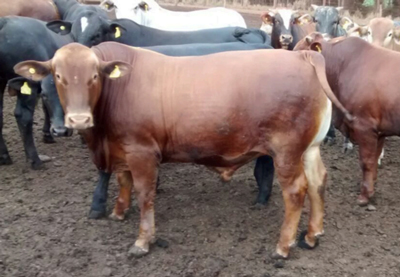 Figure 1 — Crossbreeding System
Crossbreeding system with the dams slaughtered after weaning and their offspring slaughtered at 14 months after feedlot finishing.
● Dam (female): Half-Angus, Half-Nelore heifer.
● Sire: Bonsmara bull or semen.
● Offspring: ½ Bonsmara, ¼ Angus, ¼ Nelore.
● Dam (female): slaughtered after weaning.
● Offspring: slaughtered after feedlot finishing.
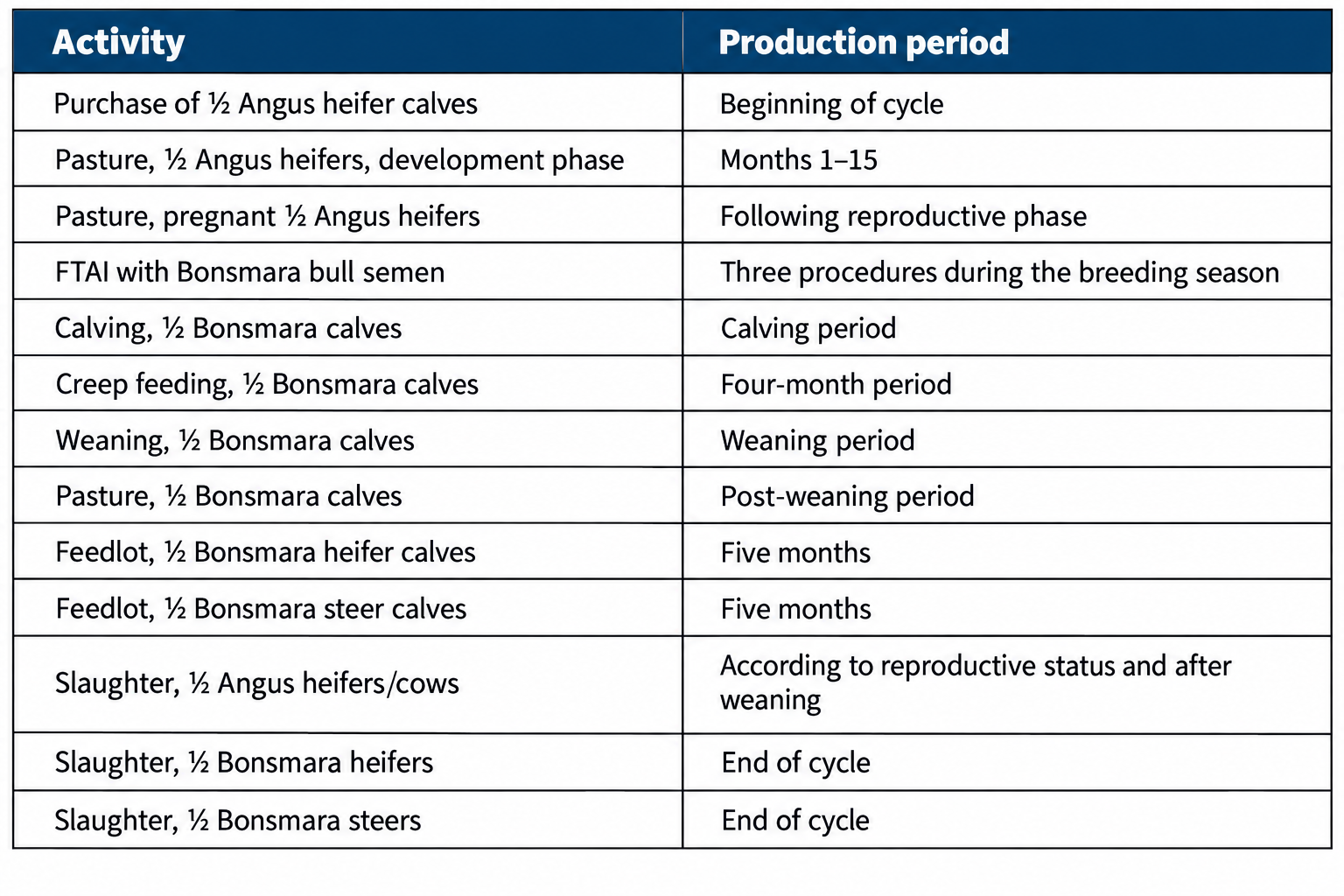
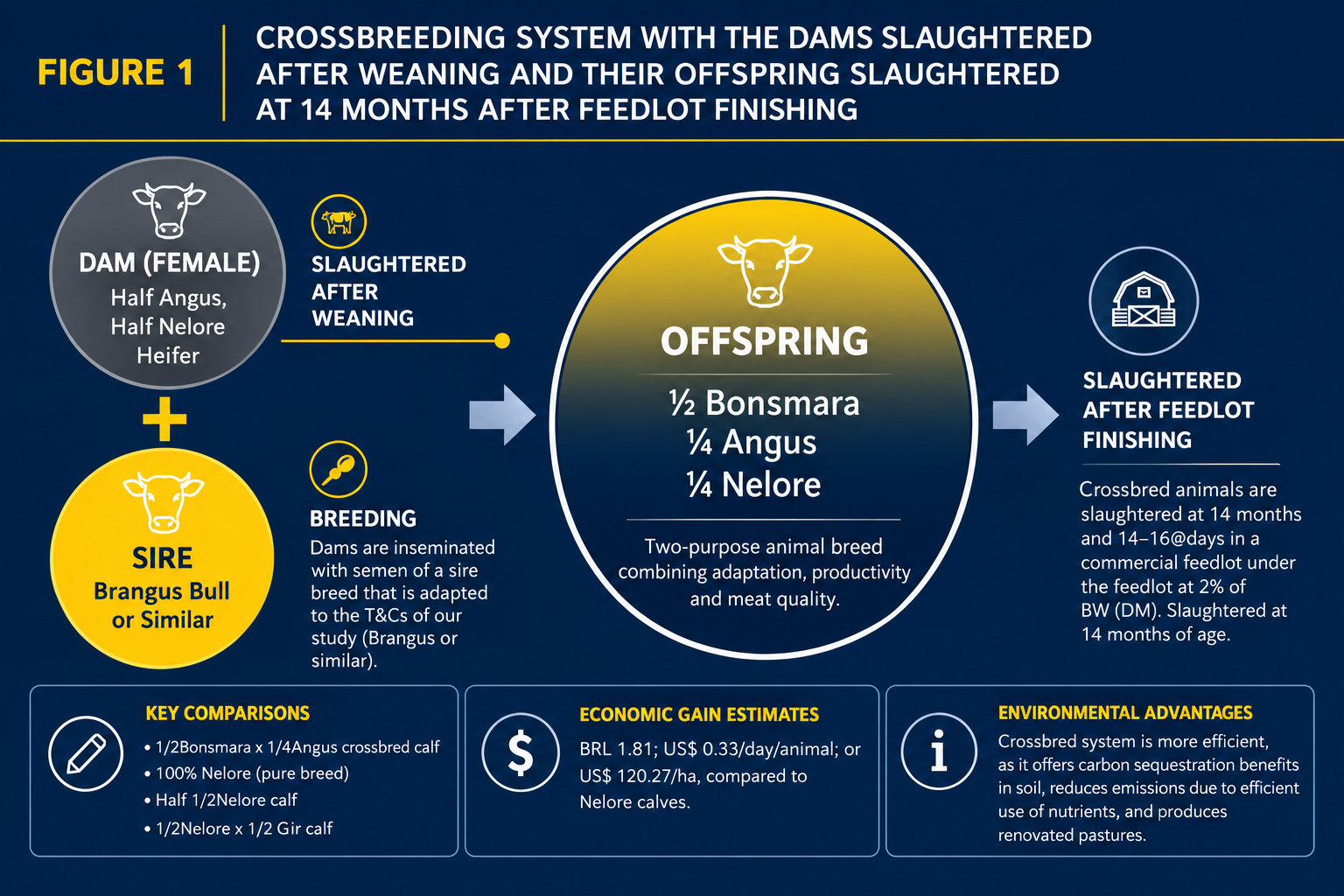 Table 1 — Schedule of Activities
Bonsmara × Half-Angus, Half-Nelore Crossbreeding System
Note: The schedule illustrates the sequence of activities throughout the approximately 32-month production cycle. For the financial evaluation, 12 months of actual pasture development for the heifer are considered.
Financial Evaluation
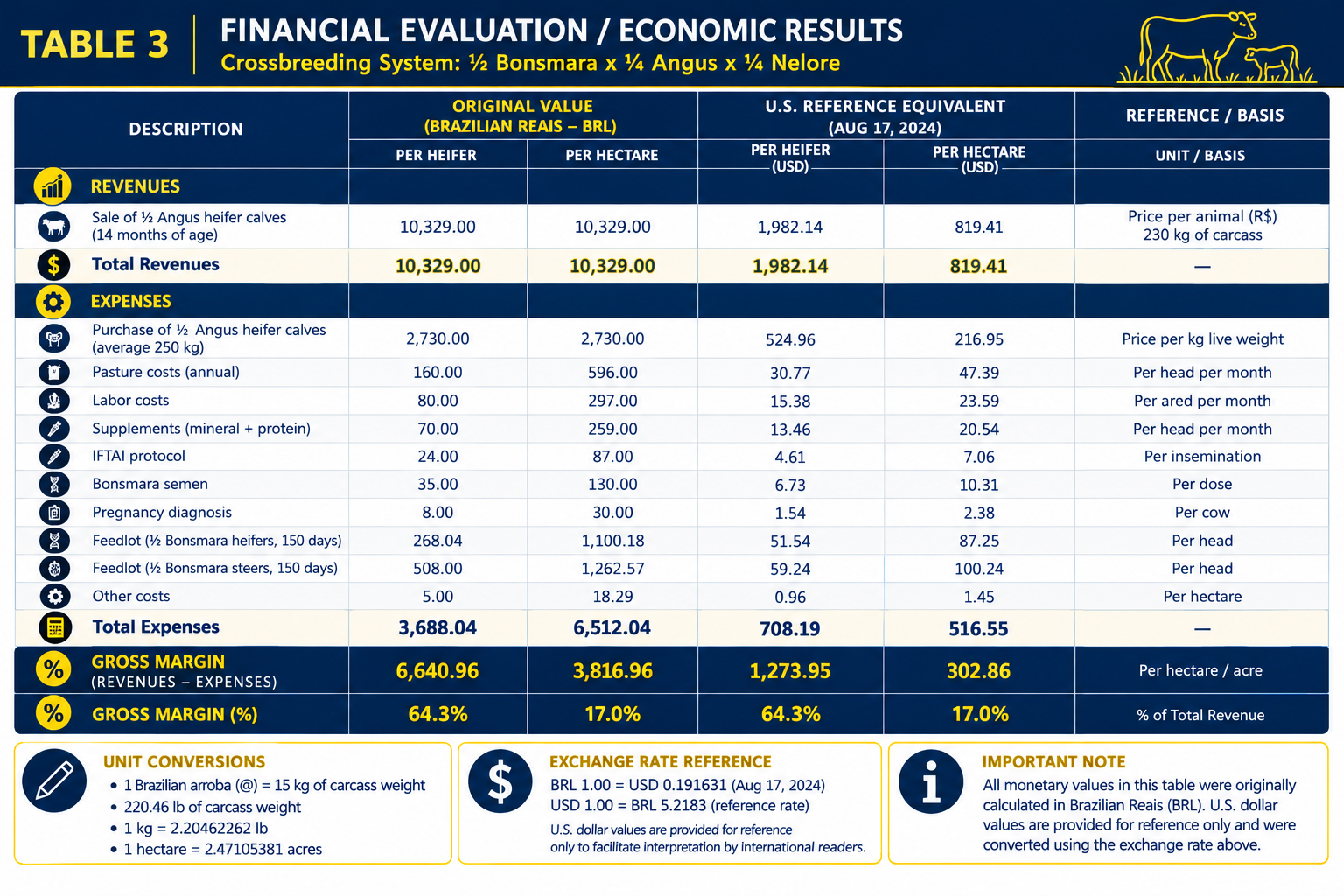
The original financial evaluation reports total revenue of BRL 10,329.00, expenses of BRL 8,571.04, and a gross margin of BRL 1,757.96 per hectare, or 17.0%. The original Brazilian-real values remain the controlling values of the analysis.
Understanding the Calculation
All values are calculated per half-Angus heifer purchased, corresponding to a stocking rate of one animal per hectare. Below, we explain how each revenue figure is calculated, particularly revenue from steer and heifer calves, which requires two adjustments.
Revenue
1. Slaughter of ½ Angus heifers/cows, the dams — BRL 5,791.50
Practically all half-Angus heifer calves purchased are slaughtered at the end of the cycle.
Those remaining open during the breeding season are slaughtered at 20 months. Those that become pregnant remain on pasture, calve, wean their calves, and are then slaughtered.
After accounting for approximately 1% mortality/culling throughout the cycle, we consider 0.99 female slaughtered for every heifer purchased:
18 @ × BRL 325.00/@ × 0.99 =
BRL 5,791.50
18 = 270 kg = 595.25 lb of carcass weight.
2. Slaughter of ½ Bonsmara steer and heifer calves, the offspring
For every half-Angus heifer purchased, we expect one half-Bonsmara offspring by the end of the cycle. Because not every female produces a calf that reaches weaning, and calves may be male or female, two adjustments are applied.
75% weaning rate: out of every 100 heifers purchased, 75 effectively wean a calf. This incorporates pregnancy losses, gestational losses, and mortality through weaning.
 Division by 2, sex ratio:
 half of the calves weaned are assumed to be male and half female.
Male calf: 0.75 × 0.50 = 0.375 head.
Female calf: 0.75 × 0.50 = 0.375 head.
½ Bonsmara steers
20 @ × BRL 345.00 = BRL 6,900.00 × 0.75 × 0.50 =
BRL 2,587.50
20 @ = 300 kg = 661.39 lb of carcass weight.
½ Bonsmara heifers
16 @ × BRL 325.00 = BRL 5,200.00 × 0.75 × 0.50 =
BRL 1,950.00
16 @ = 240 kg = 529.11 lb of carcass weight.
Total Revenue
BRL 5,791.50 + BRL 1,950.00 + BRL 2,587.50 =
BRL 10,329.00
Expenses
Expenses total BRL 8,571.04 per hectare.
Purchase of the ½ Angus heifer: 210 kg × BRL 13.00 =
BRL 2,730.00.
210 kg = 462.97 lb.
Development of the heifer on pasture for 12 months:
(BRL 60 pasture rental + BRL 70 supplement) × 12 =
BRL 1,560.00.
Maintenance of the pregnant heifer/cow for 12 months:
BRL 100 × 12 + BRL 70 × 6 during the dry season =
BRL 1,620.00.
Feedlot for 150 days: only steer and heifer calves actually weaned enter the feedlot, so the same 0.75 × 0.50 = 0.375 factor is applied.
Heifers: 0.375 × 150 × BRL 14 =
BRL 787.50.
Steers: 0.375 × 150 × BRL 16 =
BRL 900.00.
Other costs include labor (BRL 310.00), other costs (BRL 139.50), FTAI with semen (BRL 115.29), calf pasture (BRL 225.00), and creep feeding (BRL 183.75).
Result
Revenue BRL 10,329.00 − Expenses BRL 8,571.04 =
Gross Margin of BRL 1,757.96 per hectare (17.0%).
The prices used for the arroba (@) do not include any premium for carcass quality. The result is derived solely from productivity gains.
Because these animals can produce high-quality beef, there could be a quality premium for the females, which would further improve the result.
For the males, however, castration is not worthwhile in Brazil. Although it would improve finishing, the reduction in weight gain does not compensate for it under our production conditions.
These advantages motivate me to recommend this system. This does not mean it is the only or necessarily the best system, but it is the system we know and for which we already have good references.
Another breed for producing a half-blood Nelore female is Hereford. This breed is particularly interesting because of a research project developed by Embrapa Pecuária Sul,
Genomic Selection for Resistance to Cattle Ticks.
Initial studies show variability among individuals and indicate that selection for this trait is possible.
As discussed, identifying bulls with excellent performance that are also resistant to ticks is imperative for expanding crossbreeding in Brazil and fully capitalizing on the advantages of this technology.
Selection must focus on what really matters.
Best regards, and see you around!
Conversion Note for the U.S. Edition
Brazilian cattle prices are traditionally quoted in arrobas (@) of carcass weight. One Brazilian arroba equals 15 kg, or approximately 33.0693 lb, of carcass weight. Metric-to-U.S. customary unit conversions use 1 kg = 2.20462262 lb and 1 hectare = 2.47105381 acres. Monetary conversions should be presented as dated reference equivalents for international readers; the original economic analysis and calculations remain in Brazilian reais (BRL).
Selecting High-Performance Cattle Breeding Solutions for Scalable Beef Production
Beef producers across tropical and subtropical regions face a persistent constraint that goes beyond yield: how to achieve consistent meat quality without introducing systems that strain labor, infrastructure or environmental limits. Conventional approaches to genetic improvement often rely on tightly managed breeding programs, yet many of these models work only in controlled environments that do not reflect pasture-based realities. This gap between genetic potential and field execution continues to shape procurement decisions for breeding solutions.
A critical pressure point lies in the method of crossbreeding itself. Fixed-time artificial insemination has become a widely used pathway to introduce desirable traits, but it demands technical expertise, infrastructure investment and precise timing. In large, dispersed grazing systems, these requirements introduce variability and cost that dilute expected gains. Natural mating, when paired with the right genetic base, shifts this equation by enabling crossbreeding under field conditions without operational strain. The distinction is not procedural but structural: whether genetic improvement integrates into existing systems or forces systems to adapt around it.
Climate adaptability introduces another layer of decision complexity. Many high-performance breeds show limitations outside temperate regions, particularly under heat stress. This creates a fragmented breeding strategy where solutions vary by geography rather than scale. Breeding programs that prioritize adaptability at the genetic level allow producers to maintain performance across diverse climatic zones, reducing dependency on localized solutions. This continuity becomes essential in markets where herd expansion or geographic diversification is part of long-term planning.
Productivity gains are increasingly evaluated in terms of biological efficiency rather than output alone. Improvements in weaning weight, feed conversion and reproductive efficiency must align with broader economic and environmental considerations. Crossbreeding systems that unlock heterosis under practical conditions can materially increase output per animal, often without proportional increases in input. This has implications not only for profitability but also for sustainability metrics, where higher efficiency reduces emissions intensity per unit of production.
Temperament and manageability are often treated as secondary traits, yet they directly affect handling safety, labor efficiency and even meat quality. Breeding solutions that embed docility into selection criteria reduce friction across the production cycle, from pasture management to finishing. This alignment between animal behavior and operational efficiency is rarely achieved through isolated trait selection; it requires a coherent genetic strategy that integrates performance with practicality.
Fazenda Santa Silvéria positions itself within this framework by focusing on breeding solutions that prioritize adaptability, fertility and productivity under pasture-based systems. Its emphasis on the Bonsmara breed reflects a deliberate approach to enabling natural mating as a viable crossbreeding method across diverse Brazilian conditions. By maintaining genetic distance from both British and Zebu cattle, it enables heterosis in a way that enhances performance while preserving resilience.
The farm integrates performance data, visual evaluation and genomic analysis to guide mating decisions, ensuring that selection aligns with functional outcomes rather than isolated metrics. Its breeding approach supports systems where producers can increase weaning weights, improve feed efficiency and produce high-quality beef without reliance on intensive infrastructure. For executives evaluating breeding partners, it offers a model that aligns genetic advancement with field-ready execution, making it a compelling choice for scalable, pasture-based beef production.
...Read more